• Skip to main content
  • Skip to footer

Stryker

The Siege of Sadr City

  • The Book
  • The Mission
  • The Men
  • The Author

Main Content

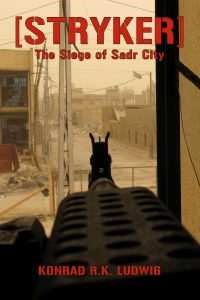
Stryker: The Siege of Sadr City

by Konrad R.K. Ludwig

The 2008 Battle of Sadr City changed the outcome of the Iraq War. Almost nobody knows it happened.

For nearly three months, Bull Company fought block-by-block through a city of 2.4 million people against an Iranian-backed militia that had twenty minutes to mass a response anywhere in the city. This is one of the few enlisted ground-level account of that battle — cited by RAND. Endorsed by the U.S. Army Center of Military History.
“This is not a book for the faint of heart… Konrad brings the reader into the world of combat, where he and his brothers roared down streets teeming with men anxious to kill them… Simply amazing… Here is a true war diary that tells you what urban combat amidst a hostile populace is actually like.”

— F.J. “Bing” West, Former Assistant Secretary of Defense

“This is an exceptional book… Sergeant Ludwig captures what so few people understand about the realities of war… I was quite moved. And, as with any great book, it puts the reader in a place… Sergeant Ludwig’s book is an invaluable complement to our study for the grunt’s eye view of this crucial battle in Operation Iraqi Freedom.”

— COL David E. Johnson, Ph.D. (Ret.), Senior Political Scientist (RAND Corporation)

“I have been studying the Battle of Sadr City at work and decided that my efforts would be enriched by using a first-person source rather than depending on official reports… The author’s writing style proved to be so refreshing and vibrant that I had a difficult time putting it down… Highly recommended. It will have a prominent place on my OIF reference shelf.”

— LTC Mark J. Reardon, Senior Military Historian (U.S. Army Center of Military History)

Buy for Kindle
Buy Paperback

The Book

Stryker: The Siege of Sadr City

Twenty years ago, the 2008 Battle of Sadr City changed the course of the Iraq War. Almost nobody knows it happened.

For nearly three months, American infantrymen fought block-by-block through the most densely populated district of Baghdad — a district with over 2.5 million residents. Their enemy was a radical fundamentalist militia known as the Jaish al-Mahdi, which had been trained and supplied by Qasem Soleimani’s Quds Force and Hezbollah’s Unit 3800.

For years, the Jaish al-Mahdi had dug into Sadr City, amassed an arsenal of sophisticated weaponry and tactics, and prepared for all-out conflagration against the United States. Bolstered by elite “special groups” of snipers and anti-armor strike teams, they maintained a twenty-minute response time anywhere in the city, fighting toe-to-toe with American special operations groups and conventional infantry who dared enter their stronghold. After five years of combat, they had earned their place as the most strategically capable adversary in Iraq.

According to RAND, the 2008 Battle of Sadr City established a new paradigm for urban combat. West Point’s Modern War Institute selected the battle as a case study in its Urban Warfare Project to train the next generation of American combat officers. The men who fought in the streets received a Valorous Unit Citation for their accomplishments.

Almost none of this made the news.

Stryker: The Siege of Sadr City is one of the few ground-level accounts of the 2008 Battle of Sadr City. Sergeant Ludwig’s gripping narrative offers an unfiltered view through the sights of his machine gun. He documents the twenty-minute countdown that governed entrance into the city, the psychological effect of maintaining a 36-hour patrol cycle for eight months, and every brutal turn in what would become one of the largest and bloodiest battles of Operation Iraqi Freedom.

This fourth revised version has been cited by the RAND Corporation in its official study of the battle. It has been endorsed by Lieutenant Colonel Mark J. Reardon (Senior Military Historian at the U.S. Army Center of Military History) and Colonel David E. Johnson, Ph.D. (Ret.) (Senior Political Scientist at the RAND Corporation). It has been used as primary source material in undergraduate and postgraduate courses on military history, foreign policy, and contemporary literature.

The Mission

Liberate Sadr City and Defeat the Mahdi Army

By 2007, the Jaish al-Mahdi — a Shia militia funded and equipped by Iran’s Revolutionary Guard Corps — had effectively governed Sadr City for years. The district housed 2.4 million people in the most densely populated urban environment in Iraq. JAM enforced their authority with Iranian-manufactured weapons, sophisticated IEDs, and an organizational structure capable of massing hundreds of fighters anywhere in the city within twenty minutes of contact.

When President Bush announced the troop surge in 2007, the 1st Squadron, 2nd Stryker Cavalry Regiment deployed to Baghdad with a specific mission: kill-or-capture raids against JAM high-value targets, pushing the militia back to the border of Sadr City while Coalition forces built a wall to cut off their supply lines.

For six months, 1/2 SCR conducted high-speed raids under the most restrictive rules of engagement of the war. Then, in April 2008, JAM broke the ceasefire. The battle — one of the largest engagements of the Iraq War — began in earnest.

For three months, Bull Company and the rest of 1/2 SCR fought block-by-block through a city of millions, against a well-armed, Iranian-backed militia that had spent years preparing for exactly this fight. They were outnumbered, spread thin, and operating under command conditions that would have broken lesser units.

They won.

Upon returning from Iraq, the men of 1st Squadron, 2nd Stryker Cavalry Regiment received the Valorous Unit Citation for their role in Operation Stryker Denial and Operation Gold Wall — the two most significant engagements of the 2008 Battle of Sadr City.

The Men

Bull Company, 1st Squadron / 2nd Stryker Cavalry Regiment

The men of Bull Company did not arrive in Sadr City unprepared. Before they were 1/2 SCR, they were the Deathmasters of 1st Battalion, 5th Infantry Regiment — veterans of Fallujah and Mosul, who had learned the hard lessons of block-to-block urban combat in some of the most dangerous battles of the Iraq War. When they re-flagged and moved to Germany, they brought those lessons with them and trained a new generation of infantry.

By the time they deployed to Baghdad in 2007, they were one of the most experienced conventional infantry units in the Army. Their mission — kill-or-capture raids against JAM high-value targets — required them to operate at the tip of the spear, night after night, against an enemy that had spent years preparing the city as a fortress.

What made them effective wasn’t just training. It was the specific, irreplaceable quality of the men themselves: leaders who answered every decision with two questions — what is morally right, and what serves the men — and soldiers who trusted each other completely because they had earned that trust before the shooting started.

The Author

Konrad R.K. Ludwig

Konrad Ludwig enlisted in the United States Army at seventeen — in May 2005, during one of the deadliest months of the Iraq War. His recruiter offered him the Pentagon, medical training, intelligence work. He asked for infantry. Two years later he was a machine gunner with Bull Company, 1st Squadron, 2nd Stryker Cavalry Regiment, deployed to the streets of Sadr City.

For a year before their deployment to Iraq, Ludwig served as his platoon’s radio technical operator — the longest-serving RTO in the brigade by the time the battle began. The position gave him something most infantry soldiers never have: simultaneous visibility into the tactical ground level and the command layer. He carried company net in one ear and platoon net in the other, sat in on briefings and handoffs, and took an active role in converting leadership objectives into actions on the ground. When he moved back to the line as a machine gunner, he took part in some of the hardest fighting of the war.

Konrad was medically discharged in 2010 following a traumatic brain injury and PTSD diagnosis sustained in combat. He went through the Army and VA mental health systems. What worked was writing. He got on his bike every morning, rode to a coffee shop, and wrote everything down. Four years later the book was done.

Stryker: The Siege of Sadr City has been cited by the RAND Corporation and used as a primary source by the U.S. Army Center of Military History. It was the first public account of the 2008 Battle of Sadr City to reach a significant audience — and when Ludwig posted a Reddit AMA in 2013, it hit the front page and stayed there for three days, as veterans and civilians who had been carrying the silence of that deployment finally found something that named what they had witnessed.

Ludwig is a graduate of Hillsdale College, where he studied Applied Mathematics and Economics. He lives in Michigan.

Footer

Information

TitleStryker: The Siege of Sadr City
PublisherRoland-Kjos Publishing
Publication DateAugust, 2013
ISBN (Paperback)0985339802
ASIN (E-Book)B00EZW0HUM
Print DimensionsTrade Paperback (6 x 9 inches)
Print Length515 Pages

Copyright © 2026 · Altitude Pro on Genesis Framework · WordPress · Log in